Within the high-stakes realm of today's professional sliding, victory is far more than purely a function of sheer horsepower or driver bravado. Rather, it has evolved into a multifaceted engineering challenge which demands a meticulous fusion of selecting a proven chassis, outfitting it with the most precise drift-spec parts, and, most essentially, grasping its live characteristics on the circuit through sophisticated suspension tuning applications. This definitive handbook acts as your blueprint from the initial concept of a drift build all the way to the final data-informed adjustments that turn a strong car into a predictable podium finisher. We will thoroughly explore the precise engineering of vehicle alignment optimization, demonstrating how a state-of-the-art vehicle dynamics tool like a dedicated telemetry system eliminates guesswork and offers unmatched visibility into your vehicle's real-world behavior.
The cornerstone of any great competitive sliding vehicle is, indisputably, the platform itself. Certain vehicles have earned legendary standing within the worldwide drifting culture due to their built-in weight distribution, robust design, and the immense ecosystem of specialist parts available. Picking the correct platform is the primary and most significant selection a enthusiast will make. For instance, the the E36 generation BMW is universally acknowledged as perhaps the the finest balanced drift platforms of all time. Its almost ideal 50/50 weight distribution, coupled with a driven rear axle layout and extremely reliable inline-six powerplants, creates a platform that is at once accessible for newcomers and highly competitive in the hands of a pro competitor. The evolution of this concept, the BMW E46 platform, improves on these qualities with a more sophisticated frame, wider stance for enhanced high-speed stability, and yet more lock as standard from the factory. A different dominant contender in the professional circuit is the Corvette C6.
This American performance car introduces a particular set of advantages to the sliding discipline, featuring a lightweight aluminum frame, a rear-mounted transaxle that aids in an ideal front-to-rear mass ratio, and the colossal torque of a large-displacement LS V8 motor. This blend renders it an utter force on track, designed of entering and sustaining continuous angles with seemingly effortless application of throttle. For those seeking exceptional bang-for-the-buck, the 350Z model Nissan rises above as a excellent candidate. It is delivered from the manufacturer with a robust platform, a competent factory limited-slip differential, and the smooth VQ35DE engine that provides ample power and torque for practicing and moving up in the discipline. Its follow-up, the 370Z model, presents additional improvements in structural rigidity, steering geometry, and outright engine output, establishing its position as a favorite choice among competitive drivers. Further iconic vehicles that warrant attention are the nimble Wankel-engined Mazda FC RX-7, the ubiquitous Nissan S13, the American Ford SN95, the more recent BMW E90, and the small yet unbelievably engaging and teachable Mazda MX-5. Every single one of these cars offers a different palette of traits, challenges, and possibilities, but they all have in common the fundamental components required to become a serious drift machine.
However, selecting the correct chassis is just the beginning. To access the true potential of every of these vehicles, substantial modifications to the steering system and chassis control systems are completely essential. This is where the realm of performance tuning hardware comes into vital focus. The most most transformative improvement for a dedicated drift machine is the installation of a maximum-angle drift angle kit. These advanced assemblies, such as those engineered by industry leaders like SLR Speed, are designed to dramatically increase the car's possible turning lock. A factory road car is severely restricted in how far its tires can turn, a engineering limitation for on-road driving. In oversteer driving, conversely, extreme opposite lock is frequently needed to catch and hold a drift. An modification kit replaces the factory uprights, rod ends, and sometimes suspension arms with components that allow the steered wheels to achieve steering lock beyond 70 or even 80 degrees, versus a typical OEM setting of around 40 to 50 °.
This vastly increased lock offers the operator with exponentially greater authority during a angle, making it far easier to initiate a drift, sustain it through a extended bend, and transition seamlessly from one side to the opposite. The improvement in drivability is nothing short of revolutionary. Paired with a properly selected angle kit is the equally vital enhancement to the chassis's spring and damper setup. Store-bought or including expensive street dampers are just not engineered for the particular and extreme demands of sliding. A dedicated set of adjustable dampers is paramount. These engineered coilovers incorporate specific valving and spring strength that are designed for the violent weight transfer that is typical of drifting. When a driver initiates a slide, the car's inertia is shifted forcefully to the outside of the turn. Correct drift-spec suspension control this movement in a controllable way, permitting the vehicle to stabilize promptly and giving the operator clear feel through the controls and cockpit. They also enable exact adjustment of stance, rebound and compression stiffness, and corner weighting, which are all fundamental aspects of dialing in the car's dynamics to a particular track or piloting style. As a system, a precision-engineered drift angle kit and a expertly selected pair of competition coilovers are the absolute hardware foundation upon which all future tuning is built.
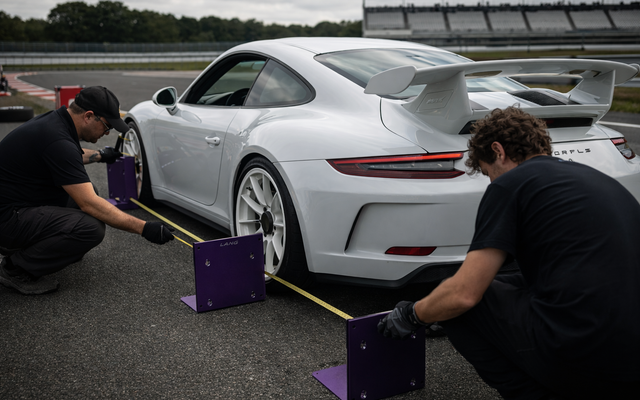
Once the core parts is in place, the next vital stage in the build is the detailed tuning of the chassis's suspension geometry. This is the realm of car suspension tuning, a process that can seem overwhelmingly complex to the newcomer but is, in practice, the secret to turning a collection of high-performance parts into a unified and controllable whole. The most debated aspect of suspension geometry for oversteer is certainly camber angle. Wheel camber is the angle of the wheel in relation to the perfectly straight line when viewed from the front-on of the car. If the top edge of the wheel is tilted towards the car, this is known as inward tilt. In oversteer driving, negative camber on the front axle wheels is generally used and is regarded as essential. The purpose is fundamentally related to physics.
When a vehicle is cornering at high slip angles, the chassis leans towards the outer of the corner. This chassis roll causes the outside front tire to lose its optimal contact patch with the tarmac. By introducing negative camber, the wheel is pre-leaned to account for this tilt. As the vehicle rolls into the turn, the tire becomes more upright on the track, increasing its grip at the precise point when it is absolutely essential for directional command. Usually, front camber settings for a dedicated sliding vehicle fall between approximately -3 degrees to as extreme as -5 degrees or even greater, depending on the specifics of the vehicle configuration, rubber choice, and operator feel. The rear axle wheels also employ inward tilt, but the angles are generally more conservative and less aggressive than the front. Excessive camber at the rear can make the car overly prone to oversteer and challenging to control on acceleration use, as it reduces the available contact patch of the driven drift telemetry software wheels during straight-line throttle application. Therefore, rear axle angles are often in the ballpark of -1 degree to -3 degrees, striking a precise compromise between giving sufficient lateral bite to help in entering and maintaining the angle while also keeping good hook-up for acceleration the bend. camber angle is merely one part of the more complex suspension geometry puzzle, which additionally involves toe, self-centering steering, and steer correction modification.
Toe angle is the angle of the wheels when looked at from above. Positive toe means the front edges of the wheels are nearer together than the trailing edges, while outward toe means the converse. For drifting, a slight amount of front negative toe is commonly run to improve the turn-in handling reaction, making the vehicle feel more agile and willing to start a slide. Rear axle toe setting is generally set to zero or a extremely minute amount of toe-in to foster stability under throttle. caster angle is the forward or backwards inclination of the suspension pivot when looked at from the lateral of the car. Positive caster improves self-centering and stability stability, and it also increases inward lean increase during steering, which is extremely useful. Adjusting these parameters is a intricate interaction where a adjustment to a single parameter can and often will influence the remaining parameters. The traditional method for setting a chassis's alignment for sliding has historically been a tedious affair of trial vehicle dynamics tool and error. A pilot or engineering group would make a change based on intuition, test the vehicle on track, depend on the operator's individual sensation and comments, and then apply a further change. This cycle would continue over and over until the car felt "good" or the available practice time ran out. This methodology is not just exceptionally inefficient in terms of man-hours and tires, fuel, and parts, but it is additionally deeply flawed.
Driver perception is a notoriously unreliable measurement tool, affected by numerous factors such as fatigue, evolving track surfaces, ambient heat, and simply the focus of the operator on that specific day. What feels "tail-happy" on one run might feel "tight" on the next pass, resulting in confusing data and counterproductive adjustments. This age-old problem in car suspension tuning is specifically where modern technology has stepped in to transform the methodology.
The advent and integration of specialized suspension tuning applications has brought about a new era for tuning and refining competitive drift cars. These tools, exemplified by innovative products like data acquisition tools, operate by actively recording the real-time dynamic performance of the car as it is being driven on the circuit. As opposed to using subjective feedback, these systems acquire quantifiable metrics on key factors such as suspension travel, wheel speed, acceleration forces, wheel angle, and accelerator and brake pedal input. This collected data stream is then interpreted by advanced software that can graph and decode the metrics in a comprehensible format. For the first time ever, tuners and builders can see specifically what the car is doing at any given point of a drift. This ability revolutionizes the complete chassis setup workflow. Imagine the aforementioned goal of dialing in the front camber for a given car. Rather than introducing a modification from -3 degrees to -3.5 degrees and then running multiple laps to try and "sense" a improvement, a suspension tuning tool can deliver instant and irrefutable data. The drift telemetry software application can indicate graphically how the tire's grip is performing during the critical moments of a angle: turn-in, mid-corner, and switch. It can show if the present value is permitting the outside front tire to maintain maximum loading or if the tire is over-stressed on its external shoulder.
The software can then provide fact-based advice for modification. Perhaps the information shows that the tire is still overworking its sidewall at -3.5 degrees of negative camber, implying that a move towards inward lean, say -4 degrees, might be advantageous. Conversely, the data might reveal that the tread is not coming up to temperature or that the inner shoulder is wearing excessively, which could point to that there is overly aggressive angle and a modest decrease back to -3.2 degrees would be more optimal. This level of precision and practical analysis was literally unimaginable in the time of solely manual tuning.
The benefit of using a comprehensive vehicle dynamics tool reaches well beyond merely setting camber angles. It becomes an essential suspension tuning guide that is tailored to your particular car. When setting the rebound and compression settings on your suspension, instead of using vague guidelines or copying another car's setup, you can employ the telemetry to analyze how the chassis is performing in response to your tweaks. The software can display the suspension travel trace over a section of track, revealing if the coilovers are controlling the body movement effectively or if they are permitting the vehicle to bounce uncontrollably after a transition. It can assist in pinpointing issues like excessive compression or topping out, allowing you to introduce informed choices to helper springs, damping settings, or stance. This process translates similarly to the detailed task of suspension geometry optimization. In addition to camber, the tool can give analysis into how changes to toe and caster angle are influencing the vehicle's balance during specific maneuvers of a slide. For instance, it can assist you to find the ideal amount of front axle negative toe for your specific steering configuration and piloting approach by showing the speed of initial response and the consistency of the car at lock countersteer. This makes the system an incredibly powerful vehicle dynamics manual that is constantly calibrated by the live dynamics of your specific chassis on the tarmac. It elevates the entire process from a mysterious craft into a scientific development procedure.
Additionally, the application of a tool like data acquisition is in no way restricted to expert tuners with large budgets. For the grassroots driver, it acts as an powerful educational tool. It in essence gives the driver with the knowledge of a professional race engineer without the associated overhead. It drastically shortens the development time by giving clear directions to challenges that would traditionally take seasons of experience to solve. A builder can learn how their specific vehicle reacts to different settings, gaining a more profound understanding of suspension theory in the endeavor. It also democratizes professional chassis dynamics principles, allowing all drivers with the desire to optimize their car to accomplish it in a structured and successful way. This is particularly significant in a sport like oversteer competition, where tuning knowledge has traditionally been a closely guarded advantage among top crews. Today, that knowledge can be in the hands of every serious enthusiast.
In the final analysis, the path to building and dialing in the ultimate high-performance sliding vehicle is a comprehensive project that seamlessly combines classic mechanical principles with revolutionary digital technology. It begins with the wise choice of a legendary chassis, then built upon the integration of non-negotiable drift-spec parts like maximum-angle angle modification systems and properly specified performance adjustable dampers. The build then progresses into the precision phase of car suspension tuning, where settings like camber, toe setting, and caster are precisely adjusted to match the car's new hardware and the operator's personal needs. Finally, and what really separates the contemporary process from the traditional methods, is the integration of a advanced drift telemetry software. This tool eradicates the approximation and inefficiency of solely subjective setup by giving objective, live information on how the chassis is actually behaving. It functions as an unparalleled suspension tuning tool, a actionable coilover setup manual, and a all-in-one performance analyzer. As a complete package, this holistic philosophy ensures that all component of the drift car—from the choice of the chassis to the last tweak on the damper—is refined for maximum competitiveness on the competition venue. It signifies the total maturation of the sport of drifting, merging raw driving skill with precise chassis dynamics to create the most competitive cars imaginable.